If you're looking for a wig online and are overwhelmed by the vast selection of options, please take a few minutes to read the following article. We will help you understand the differences between synthetic and human hair wigs.
We will guide you through the various aspects of wigs, from the wigs types, wigs raw material names, characteristics of the wig materials, to wig quality, durability, cleaning, maintenance, and price, helping you become an expert in the wig industry.
1. Types of wigs:
Wigs can be classified according to four main dimensions: Material, Manufacturing Process, Hairstyle,and Intended use.
Type By Material
This is the most crucial classification, determining both price and quality.
| Type | Description | Advantages | Disadvantages |
|---|---|---|---|
| Human Hair | 100% real human hair, sourced from regions like China, India, Brazil, Myanmar. |
|
|
| Synthetic Fiber | Chemically produced fibers like Kanekalon, Toyokalon (High/Low Heat). |
|
|
| Blended Hair | Mix of human & synthetic hair (e.g., 70% human / 30% synthetic). |
|
|
Type By Construction
This determines the realism, comfort, and price of the wig.
| Type | Description | Key Features | Ideal For |
|---|---|---|---|
| Machine-Made (Wefted) | Hair is sewn onto elastic bands by machine; cap is often wefted. | High production, cost-effective, dense hair volume; less breathable, cap base can be detectable. | Daily wear, costume use, budget-conscious consumers. |
| Hand-Tied (Hand-Knotted) | Hair is individually hand-knotted onto a soft, fine mesh cap. | Extremely realistic; natural hair movement; highly breathable; lightweight; allows versatile parting. | High-end clients seeking ultimate realism, individuals with hair loss. |
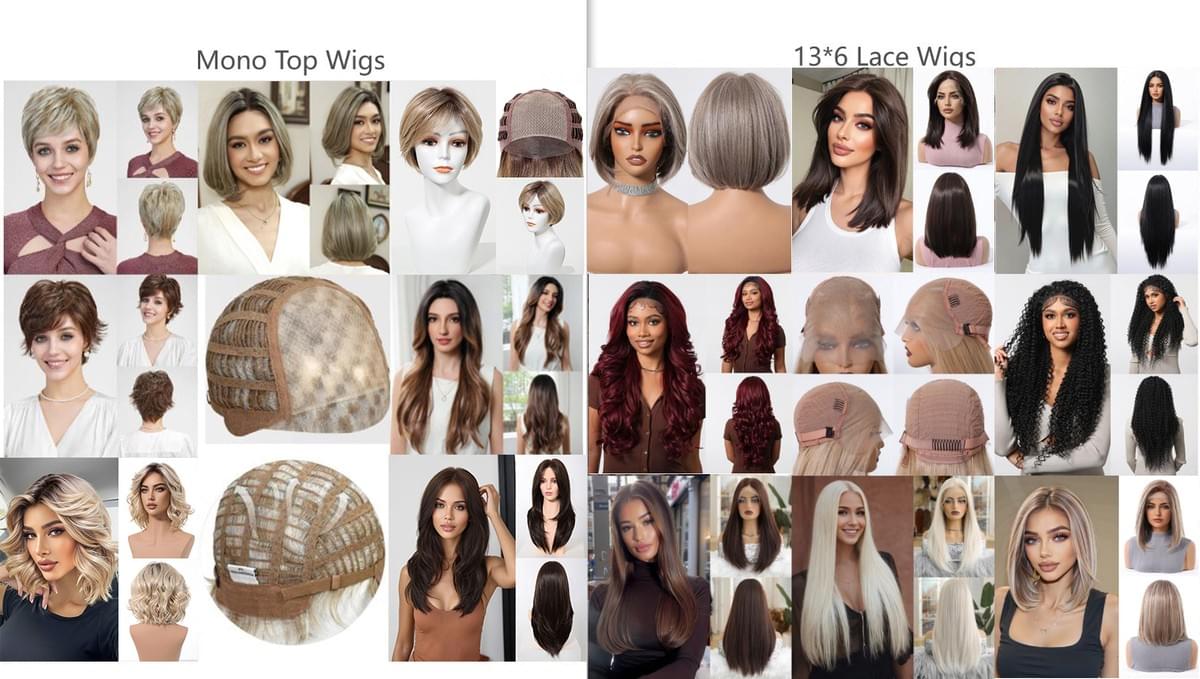
| Lace Wigs | Features a base made of sheer Swiss or French lace, especially at the front/hairline. | Creates a "scalp-like" illusion; hairline appears natural; allows styling hair away from the face; top-tier craftsmanship. | Celebrities, models, clients demanding an undetectable hairline. |
Type By Style & Production Form
This determines the realism, comfort, and price of the wig.
| Category | Common Product Types | Characteristics & Uses |
|---|---|---|
| Style | Straight, Body Wave, Curly, Afro Kinky, Bob cut, etc. | Meets diverse fashion and ethnic hairstyle needs. |
| Product Form |
Full Wigs: Covers the entire head. Wig Pieces/Toppers: For adding volume to specific areas (top, crown, fringe). Hair Extensions: Wefts or strands for adding length and volume to natural hair. |
Full Wigs: Completely changes hairstyle; suitable for hair loss or dramatic style changes. Wig Pieces/Toppers: Used for localized volumizing or framing the face. Hair Extensions: Widely used in salons to create longer, fuller hairstyles. |
2. Raw Materials of Wigs:
Synthetic Wigs:
Synthetic wigs, an important component of the modern wig industry, are not made from natural hair, but from synthetic polymer fibers derived from petrochemicals, primarily polyvinyl chloride (PVC) and polyester fibers. Through advanced spinning technology, these materials are molded into fibers that realistically mimic the form and luster of human hair.
Based on their heat resistance and intended use, synthetic fibers are mainly divided into two categories:
①low-temperature fibers
Low-temperature fibers, often referred to as standard synthetic fibers, have a low setting temperature. The fibers are heat-treated during manufacturing to create a fixed curl or wave pattern. They cannot be restyled using high-temperature tools such as curling irons, as this would cause the fibers to melt and be damaged. Their main advantages are extremely vibrant and long-lasting colors, and the most competitive production costs. This makes them ideal for making disposable, brightly colored fashion wigs and some low-cost cosplay wigs.
②high-temperature fibers
High-temperature fibers are a technological upgrade in the field of synthetic fibers, represented by brands such as Kanekalon and Toyokalon, with new fibers like Futura constantly emerging. These fibers are modified through special processes to withstand high temperatures of approximately 180°C to 200°C, allowing for limited styling adjustments using specialized low-temperature curling irons, thus achieving a certain degree of styling flexibility. Their fiber texture is significantly superior to low-temperature fibers, being smoother, more realistic, and with a luster closer to real human hair. Although more expensive, due to their significantly improved durability, realism, and styling freedom, high-temperature fibers have become the mainstream and preferred material in the global mid-to-high-end synthetic wig market.
Human Hair Wigs:
As we mentioned in the wig classification section, the raw material for human hair wigs mainly comes from human hair from different countries and regions. Due to differences in local environment and ethnicity, the quality of the human hair raw material varies.
For example, Brazilian hair, highly regarded in the industry, is known for its excellent resilience, natural luster, and outstanding curl retention. This is mainly due to the local climate and the characteristics of the population. Brazil has a tropical climate with high humidity, and the hair of the local people (especially those of mixed race) naturally possesses healthy elasticity and fullness, with thicker and tighter cuticle layers. This makes Brazilian hair more resistant to damage when processed into straight hair or subjected to perming and dyeing. The resulting curls are elastic, less prone to collapsing, and maintain their full shape for a long time. Furthermore, Brazilian hair colors are mostly concentrated in medium to dark shades, transitioning naturally from dark brown to medium brown. This makes it ideal for high-end wig products that aim for a natural, mixed-race look or require frequent styling. Therefore, it is one of the representatives of high-end human hair raw materials in the international market.
After classifying the raw materials by region, we further categorize them based on the hair's original form and processing methods, which directly determine the texture and intended use of the finished product.
①Virgin Hair (Primary cutting), also known as original hair, virgin hair, or cuticle-intact hair, is hair cut from the heads of young girls that has never been permed or dyed. It is the most expensive type of hair material, retaining the hair's natural cuticles, and the ends are not reversed.
②Remy Hair is hair that has been sorted so that the roots and ends are aligned in the same direction.
③Non-remy Hair is hair that falls out during brushing and still has the roots attached. The roots and ends are not aligned, and it requires acid treatment before use. The hair quality is generally softer, and it has a shorter lifespan.
3. The differences in maintenance and care between synthetic fiber wigs and human hair wigs:

You can also use a specialized wig care solution for regular maintenance, which provides comprehensive protection and enhancement for your wig.
Its gentle formula effectively cleanses deeply, removing styling product residue and oil, while powerfully neutralizing static electricity, preventing frizz and tangling from the root, ensuring smooth and easy combing.
The nourishing ingredients, such as keratin and silk protein, penetrate and repair damaged hair cuticles or fiber surfaces, significantly restoring the wig's smooth texture and natural shine, making it look healthier and fuller.
In addition, some products contain UV filters, which form a protective film to effectively slow down fading and aging caused by sunlight, especially providing significant protection for brightly colored synthetic wigs. Consistent use is the most economical and effective way to maintain your wig's perfect style and extend its lifespan.
For more detailed care instructions, please refer to the following articles:
4. Price Range Reference:
Finished Synthetic Wig Price Overview
Finished Human Hair Wig Price Overview
Hopefully, the information above will help clarify any questions you may have about different types of wigs, allowing you to make the best choice when selecting your ideal wig.
If you still require further information about wigs, welcome to visit our website(www.3eautywigs.com) and contact our wig consultants. You will receive information about different types of wigs and a free price list.